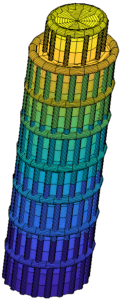
Low-rank structures appear in an astonishing variety of scientific and engineering problems. From compressing images and videos, to reconstructing incomplete data in tomography, to accelerating the solution of large-scale differential equations, low-rank approximations offer a unifying principle: complex, high-dimensional data often live close to a much simpler, low-dimensional representation.
In this talk, we will introduce the concept of low-rankness and explain why it arises so naturally in applications. We will then explore how exploiting low-rank structure leads to dramatic gains in efficiency, both in terms of storage and computation, and present concrete examples from imaging, tomography, numerical PDEs, video recognition, and beyond. The goal is to convey the ubiquity and power of low-rank methods, and to provide an accessible overview of the mathematical ideas that make them such a central tool in modern computational science.
Matrix functions play a central role in many areas of scientific computing, ranging from differential equations and network analysis to quantum mechanics and data science. Common examples include the matrix exponential, logarithm, square root and sign function. In many applications, one is interested not in the full matrix function f(A), but only in its action on a given vector, i.e. the product f(A)b. Krylov subspace methods offer an efficient way to perform this task, by relying only on matrix–vector products or linear system solves, rather than forming f(A) explicitly. By projecting the problem onto a low-dimensional polynomial or rational Krylov subspace built from A and b, these methods compute accurate approximations whose convergence is closely related to the quality of polynomial and rational approximations of the scalar function f.
The goal of this talk is to provide a broad and accessible introduction to Krylov subspace methods for matrix functions.
We begin by recalling the fundamental ideas of polynomial and rational approximation for scalar functions, which form the theoretical foundation of these methods. Building on this intuition, we will explore how Krylov subspaces can be used to approximate f(A)b efficiently, and highlight how the underlying polynomial and rational approximations lead to algorithms with distinct computational and convergence properties. Throughout the talk, we will demonstrate these concepts with a series of illustrative numerical examples.
Many networks include both allies and adversaries, excitations and inhibitions, agreements and disagreements. Signed networks offer a formal way to represent these interactions, but negative edges introduce many challenges in standard notions like communities, distances, and centralities. In this talk, I will present the most common concepts and methodologies used in the study of signed networks, with a focus on structural balance and mesoscale structures. I will then introduce the Gremban expansion, a method that transforms signed networks into unsigned ones without information loss. This framework enables a principled separation between communities and factions, addressing the limitations of existing algorithms (which typically recover only factions).
Toeplitz matrices appear in many applications such as signal processing, time series analysis, and the discretization of differential and integral equations. Their defining feature-constant diagonals-implies that they contain only linear information. However, when computing functions of Toeplitz matrices, this structure appears to be lost.
In this talk, we present an approach for efficiently approximating f(T) by uncovering hidden structure. The key idea is to transform the Toeplitz matrix into an equivalent representation that can be well approximated by hierarchical low-rank formats. This structure is numerically preserved by matrix functions, and its computation can be improved using low-rank update techniques.
Biological systems of cells and cytoskeletal elements can form a nematic phase where elongated fibres align parallel to each other, inducing partial orientational order. This order is described by a macroscopic director field that reflects the local orientation of the system. Topological defects in the nematic order are singularities in the director field; they are quite common and classified by their topological charge.
The emergence of nematic order from an initially isotropic, or disordered, organization of the fibres on deformable closed surfaces plays a pivotal role in the morphogenesis of active biological matter. A notable example is the regeneration of Hydra, a freshwater basal invertebrate: an excised fragment first folds into a spherical shell in an approximately isotropic state, and nematic order subsequently develops in the actin fibres of the epithelial tissue. On a surface with the topology of a sphere, the formation of topological defects is unavoidable, with a global constraint requiring the total topological charge to equal +2.
In this talk, I present a continuum model that couples the two-dimensional Landau-de Gennes order tensor, which describes the in-plane nematic ordering, with the mechanics of a mass-conserving, deformable spherical shell. By investigating the isotropic-to-nematic phase transition driven by a reduction in temperature, mimicking the natural induction of nematic order in actomyosin fibres, we perform both linear and weakly non-linear bifurcation analyses. We demonstrate that the onset of nematic ordering spontaneously breaks spherical symmetry, yielding distinct equilibrium morphologies governed by the shell’s deformability. Axisymmetric configurations, characterised by two +1 topological defects at the poles, emerge via a discontinuous (transcritical) bifurcation, resulting in a globally stable prolate shape with meridional director alignment, alongside a metastable oblate shape. Conversely, non-axisymmetric configurations, featuring four +1/2 defects arranged in a squared geometry, arise via a continuous (supercritical) bifurcation. We reveal that shell softness drives the first-order nature of the transition; in the limit of infinite stiffness, all bifurcations become continuous. Furthermore, our analysis indicates that integer defects strongly couple with local mass redistribution, manifesting as shell thinning or thickening, whilst half-integer defects induce no such local deformation. These findings provide a purely mechanical framework for understanding the formation of the body axis, which determines the future positions of head and foot, as well as defect-mediated morphogenesis in biological vesicles.